


Repairing Circuit Breakers (CB) – Constant Tripping & Power Failures | Dai Phong Group On-Site Electricians
A Circuit Breaker (CB) that trips repeatedly, refuses to stay on, or trips again after just a few seconds is a dangerous electrical fault. This issue can lead to explosions, short circuits, appliance damage, and even threaten personal safety.
Dai Phong Group provides professional on-site inspection and CB troubleshooting services within 15 minutes, with rapid response teams available across Ho Chi Minh City & Da Nang.
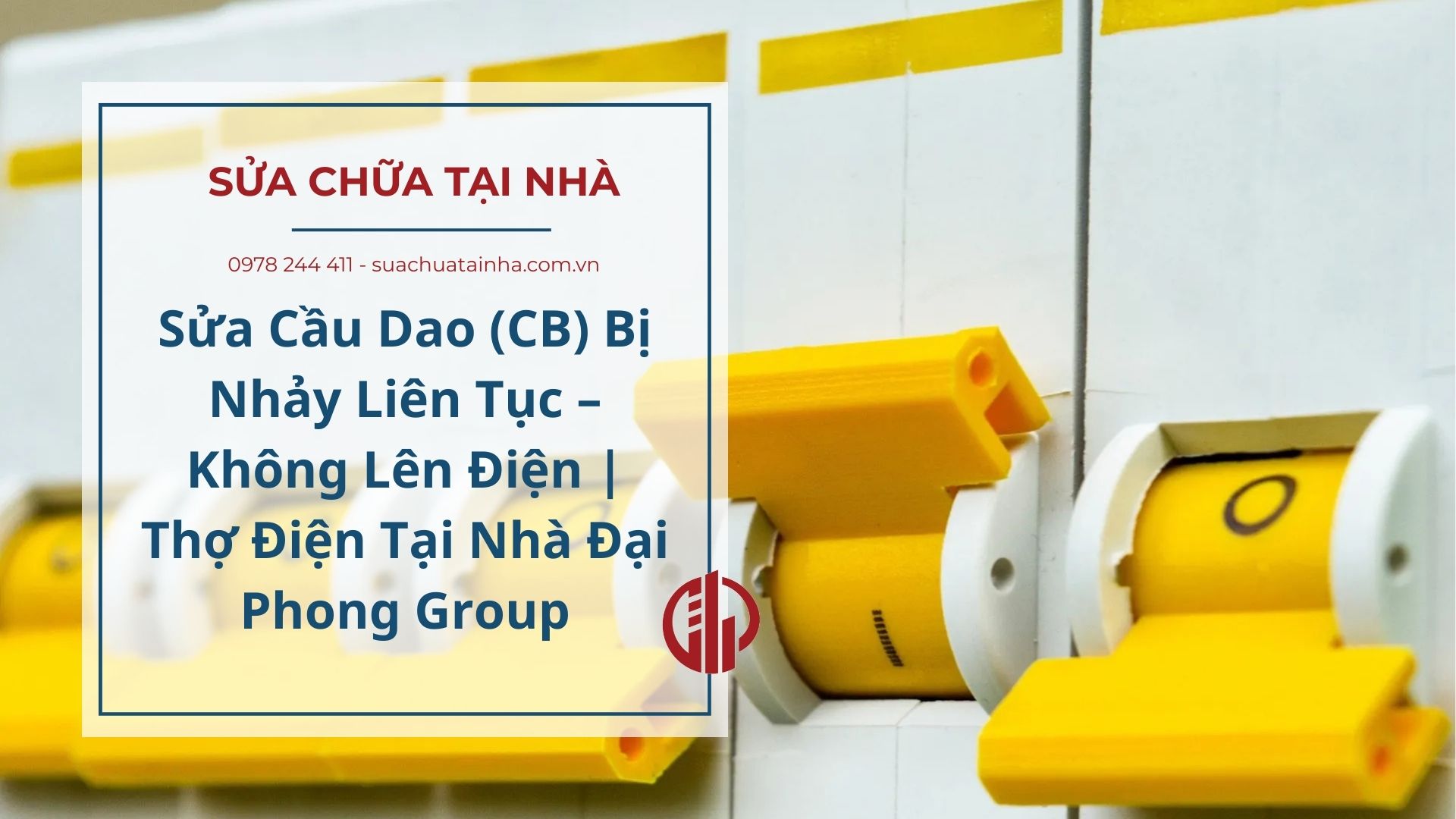
1. Signs of a Faulty Circuit Breaker (CB) – Early Diagnosis to Prevent Fire and Explosion
A circuit breaker that trips repeatedly usually exhibits the following warning signs:
-
Trips immediately upon being switched on
-
→ Cause: Electrical short circuit, severe overload, or mechanical failure within the breaker itself.
-
-
Trips after a few seconds or minutes
-
→ Cause: Current leakage (ground fault) or a hidden short circuit within a household appliance.
-
-
Cannot be switched on (lever falls back instantly)
-
→ Cause: The current demand is significantly exceeding the CB’s rated capacity (Total Overload).
-
-
CB feels abnormally hot or emits a burning smell
-
→ Cause: Level 3 Danger – High risk of electrical fire or explosion.
-
-
Partial power loss in specific areas of the house
-
→ Cause: Failure of a branch circuit breaker or damaged in-wall wiring.
-
2. Reasons Why Your Circuit Breaker (CB) Trips Repeatedly

2.1. Short Circuit (Most Common Cause – 70%)
Occurs when active and neutral wires touch due to rodents chewing through insulation, water leakage into conduits, improper wiring connections, or faulty outlets.
2.2. Power Overload
Occurs when too many high-power appliances are used simultaneously, such as air conditioners, water heaters, and induction hobs, exceeding the breaker’s rated capacity.
2.3. Electrical Leakage – Ground Faults
Current leaking to the metal casing of appliances like refrigerators, washing machines, water pumps, or water heaters. This triggers the safety mechanism of ELCB/RCCB breakers.
2.4. Mechanical Failure of the CB
After long-term use, internal springs lose their tension, or the electrical contact points become worn and corroded, causing the breaker to fail or trip falsely.
2.5. Damaged, Broken, or Melted In-Wall Wiring
Degraded insulation or melted wires within the wall are extremely dangerous and impossible to inspect without specialized diagnostic equipment.
2.6. Faulty Household Appliances
If a single device (e.g., a fan, kettle, or TV) has an internal short circuit, it can cause the Main CB to trip repeatedly to protect the entire house.
3. Circuit Breaker (CB) Repair Protocol
Our standardized 6-step process ensures maximum safety and technical precision:
Step 1 – Initial Inspection & Load Assessment
-
Action: Evaluate the breaker’s rated current, check for abnormal heat, and measure the actual power consumption load.
Step 2 – Specialized Diagnostic Testing
-
Action: Utilize high-precision Leakage Testers and Megohmmeters to check the insulation integrity of in-wall wiring.
Step 3 – Fault Isolation
-
Action: Systematically disconnect individual electrical branches to pinpoint the exact location of the short circuit or fault.
Step 4 – Repair & Component Replacement
-
Action: Replace damaged wiring, re-secure electrical joints, or install a new Safety Breaker (ELCB/RCCB) if the old unit is compromised.
Step 5 – Operational Load Test
-
Action: Perform a live test by running all household appliances simultaneously to ensure the system remains stable under full load.
Step 6 – Handover & Warranty
-
Action: Complete the final safety check and issue a 6–12 month warranty. We commit to absolute safety and technical excellence.
4. Cầu Dao (CB) Nhảy Liên Tục Có Nguy Hiểm Không? (Có – Và Rất Nguy Hiểm)
CÓ. Và mức độ nguy hiểm rất cao.
Cầu dao (CB) nhảy liên tục là tín hiệu cảnh báo hệ thống điện đang gặp sự cố nghiêm trọng, có thể dẫn đến cháy nổ trong vài phút nếu không xử lý kịp thời.
Dưới đây là 4 lý do khiến CB nhảy trở thành một tình trạng cực kỳ nguy hiểm đối với nhà ở, cửa hàng, văn phòng:

Dưới đây là bản dịch tiếng Anh chuyên nghiệp cho mục số 4, sử dụng ngôn ngữ cảnh báo mạnh mẽ và các thuật ngữ kỹ thuật để nhấn mạnh mức độ nghiêm trọng của sự cố:
4. Is a Constantly Tripping Circuit Breaker (CB) Dangerous? (YES – Extremely Dangerous)
YES. The danger level is critical. A circuit breaker that trips repeatedly is a “Red Alert” signal that your electrical system is experiencing a severe malfunction, which could lead to a catastrophic fire within minutes if not addressed immediately.
Here are 4 reasons why a tripping CB is an emergency for homes, shops, and offices:
4.1. Tripping Due to Short Circuits – The #1 Cause of House Fires
When wires short-circuit due to:
-
Rodent damage.
-
Melted in-wall insulation.
-
Charred outlets or switches.
-
Water ingress into the wiring. → The CB trips to isolate the fault. Attempting to reset it multiple times creates intense electrical arcs that can cause wires to explode and ignite surrounding materials. Statistics show that 60–70% of house fires in Vietnam originate from electrical short circuits.
4.2. Tripping Due to Overload – Overheated Wires and In-Wall Fire Risks
Simultaneous use of high-power appliances (Air Conditioners, Induction Hobs, Boilers, Water Heaters, Dryers) can exceed the CB’s capacity. If you keep forcing the breaker back on:
-
Wires become red-hot and melt their plastic insulation.
-
Junctions overheat and spark.
-
Outlets may literally explode. → This places the entire structure at high risk of a hidden in-wall fire.
4.3. Tripping Due to Ground Faults – Fatal Electrocution Risk
Safety breakers (ELCB/RCD) trip when they detect current leakage from:
-
Water heaters and pumps.
-
Washing machines and refrigerators.
-
Air conditioning units. A leakage of >30mA is enough to be fatal. If your breaker trips—especially when turning on a water heater or pump—stop using it immediately to avoid electrocution.
4.4. Defective Breakers That Fail to Trip – 5X More Dangerous
A breaker that is stuck, has a weak spring, or is of poor quality might fail to trip during a short circuit. This leads to:
-
Electrical panel fires.
-
Total destruction of household appliances.
-
Widespread in-wall fires. This is why electrical engineers strictly advise against using low-quality or counterfeit breakers.
🎯 Critical Conclusion
-
👉 Repeated Tripping = Red Alert. Your system is in danger.
-
👉 DO NOT reset the breaker repeatedly.
-
👉 DO NOT attempt to dismantle the CB or outlets yourself.
-
👉 IMMEDIATE inspection is required to prevent explosions and ensure family safety.
Dai Phong Group arrives in 15–30 minutes to provide professional, safe, and long-term guaranteed solutions.
5. Price List: Circuit Breaker (CB) Repair & Troubleshooting
Pricing for constant tripping and power failure issues.
| Service Item | Reference Price (VNĐ) |
| On-site CB Diagnostic & Inspection | 100,000 – 150,000 |
| Repairing Shorted Outlets & Switches | 120,000 – 250,000 |
| In-wall Wiring Repair & Scorched Wire Treatment | 250,000 – 450,000 |
| CB Replacement (16A – 32A – 63A) | 150,000 – 650,000 |
| Overload Resolution & System Upgrades | 300,000 – 1,200,000 |
> Note: Prices may vary based on the extent of the damage. Our technicians will provide a final, firm quote after the on-site inspection and before any work begins.
6. When Should You Call an Electrician IMMEDIATELY? (Real-World Scenarios)
Based on Dai Phong Group’s experience servicing over 2,000 households, the following situations are extremely dangerous and require urgent intervention:
-
The Main CB trips and is accompanied by a burning smell
-
→ Risk: In-wall wiring is actively burning (We have recorded cases where fire spreads in as little as 3 minutes).
-
-
The CB trips during rainfall
-
→ Risk: Water is leaking into electrical conduits or panels – an extremely high-voltage hazard.
-
-
The CB trips the moment you turn on the Water Heater
-
→ Risk: The heater has a dangerous current leak – posing a fatal electrocution risk.
-
-
The CB trips whenever the Fridge, Washing Machine, or AC is turned on
-
→ Risk: The appliance has a severe internal short. Do not attempt to plug it back in.
-
-
The CB emits “fizzing/crackling” sounds or feels abnormally hot
-
→ Risk: The breaker is about to catch fire or explode – Replace immediately.
-
-
Sparking or “popping” occurs when plugging into an outlet
-
→ Risk: The outlet or wiring is compromised, posing an immediate risk of burns or fire.
-
👉 These situations cannot wait. They must be resolved within 30 minutes to ensure safety.
7. Benefits of Technically Correct Circuit Breaker (CB) Repairs & Upgrades
Repairing or upgrading a circuit breaker according to professional technical standards does more than just prevent fires—it determines the overall safety of your entire electrical grid. The CB acts as the “safety valve” of your home; if installed incorrectly, even a brand-new system can trigger a fire at any moment.
Here are 7 critical benefits that every homeowner should understand:
7.1. Root-Cause Fire Prevention – Protecting Lives and Property
A high-standard CB will automatically trip the moment it detects:
-
In-wall wiring shorts.
-
Faulty appliances or current leakage.
-
Overloaded or overheated wires. Standard breakers feature a rapid trip speed of 0.04–0.1 seconds, completely halting fire spread—crucial for homes with children, the elderly, or high-power appliances.
7.2. Reducing System Strain – Extending Appliance Lifespan
A weak or incorrectly rated CB causes unstable current fluctuations, leading to:
-
Burnt air conditioner control boards.
-
Failed refrigerator compressors.
-
Reduced water pump lifespan.
-
Damaged adapters for phones and TVs. Result: After a proper upgrade, stable current flows can extend appliance life by 1.5–2 times.
7.3. Significant Energy Savings Through System Stability
A technically sound CB ensures your electrical system operates with:
-
Minimal energy loss and less heat dissipation in wires.
-
Zero current leakage.
-
No constant “On/Off” cycling. Homes with standardized breakers and correctly sized wiring typically save 5–15% on monthly electricity bills.
7.4. Preventing Total Blackouts – Uninterrupted Living
Substandard breakers often cause “nuisance tripping” or cut power to the entire house when only one room is overloaded. Professional load balancing ensures that faults remain localized, so a kitchen overload won’t leave your entire home in the dark.
7.5. Compliance with Safety Standards (Residential & Commercial)
Modern properties must meet strict safety standards such as:
-
TCVN 9206:2012 – Electrical installations in buildings.
-
TCVN 7447-5-52:2010 – Protection against overcurrent and short circuits. Upgrading your CB ensures your property remains compliant, which is vital for mini-apartments, shops, and rental offices.
7.6. Future-Proofing for Power Expansion
As families add high-power devices (ACs, water heaters, dryers), a professionally installed CB system allows for:
-
Capacity upgrades without needing to re-wire the entire house.
-
Guaranteed stability when adding new equipment.
-
Cost-effective system expansion in the future.
7.7. Reliability & Minimal Maintenance
Genuine breakers have a lifespan of 8–12 years, whereas cheap alternatives fail within 1–2 years. Professional upgrades prevent sudden power failures, electrical panel fires, and the extreme danger of a “stuck” breaker that fails to trip during a fault.
🎯 Expert Advice from Dai Phong Group Engineers
-
✔ If the CB trips repeatedly: DO NOT reset it multiple times.
-
✔ If the CB feels hot or smells burnt: SHUT OFF the power immediately.
-
✔ If using multiple high-power devices: UPGRADE your CB and re-balance the loads.
Our Specialized Services:
-
Standardized CB and electrical panel inspections.
-
Installation of RCCB/ELCB (Leakage protection) and MCB (Overload protection).
-
Load upgrading and safe circuit partitioning.
-
12–24 Month Extended Warranty.
On-site in 15–30 minutes – Supporting all of HCMC, Thu Duc City, and Da Nang.
8. FAQ – Frequently Asked Questions (CB Repair & Safety)
8.1. Why does my Circuit Breaker (CB) trip repeatedly?
There are three main causes for constant tripping:
-
Short Circuit: At an outlet, switch, or within in-wall wiring.
-
Overload: Using too many high-power appliances simultaneously (AC, water heater, induction hob).
-
Current Leakage: Faulty appliances like refrigerators, washing machines, or water heaters leaking electricity. 👉 Note: If the CB trips immediately after being reset, a dangerous fault is active and requires professional inspection.
8.2. Is an abnormally hot CB dangerous?
YES. A hot breaker is a warning sign of:
-
Overloaded circuits.
-
Low-quality or counterfeit components.
-
Loose connections causing electrical arcing.
-
Imminent breaker failure.
-
Action: Shut off the power and call a technician to prevent an electrical fire.
8.3. Should I try to reset the CB multiple times when it trips?
No. Continuously resetting a CB while a short or leak is present can cause:
-
Wires to become red-hot.
-
Insulation to melt or catch fire.
-
Outlets to explode. This is a leading cause of house fires in Vietnam.
8.4. Does the CB tripping when the water heater is on mean current leakage?
Very likely. When a safety breaker (ELCB/RCD) trips during water heater use, it often indicates:
-
A leaking heating element.
-
Damp power cords or water ingress into the unit.
-
A faulty RCD mechanism. 👉 Danger: Continued use poses a fatal risk of electrocution.
8.5. How often should a CB be replaced?
Average lifespans are as follows:
-
Standard MCB: 5–7 years.
-
High-quality ELCB/RCCB: 8–12 years.
-
Budget/Low-quality CB: Often fail within 1–2 years. 👉 We recommend a safety inspection every 6–12 months.
8.6. What are the signs of a failing CB?
You can identify a failing breaker by:
-
The lever not engaging (“spongy” feel).
-
Tripping under low or no load.
-
Constant “fizzing” or “popping” sounds.
-
Visible scorch marks or yellowing of the casing.
8.7. Why does my CB trip when I turn on the Air Conditioner (AC)?
Common causes:
-
The AC power cable is undersized.
-
A seized compressor or fan motor.
-
Excessive dust in the outdoor unit causing a high start-up current.
-
An incorrectly rated CB for the AC’s load.
8.8. Is it normal for a CB to trip during rain?
NO. Rain-related tripping indicates:
-
Water leaking into outdoor outlets.
-
Roof leaks dripping into electrical conduits or panels.
-
Unsealed outdoor electrical boxes. This is a sign of extremely dangerous leakage that must be fixed immediately.
8.9. Which CB brands are the best?
Our engineers recommend:
-
Panasonic (Japan): High durability, rapid response.
-
Schneider (France): Industry standard, highly reliable.
-
Mitsubishi (Japan): Excellent for residential and commercial use.
-
LS (South Korea): Good balance of price and quality.
-
ABB (Switzerland): European standard for large-scale projects.
8.10. Does a tripping CB increase my electricity bill?
Yes. Constant tripping indicates overloads, leakage, or unstable operation—all of which lead to energy waste. Faulty systems can increase bills by 5–20%.
8.11. Should I have separate CBs for different rooms or appliances?
Yes. A standard system should have dedicated circuits for:
-
Lighting / Outlets.
-
Air Conditioners / Water Heaters.
-
High-power kitchen appliances. Proper circuit partitioning prevents a single fault from blacking out the entire house.
8.12. When should I call an electrician immediately?
Call Dai Phong Group right away if:
-
The CB trips and smells like burning plastic.
-
An outlet sparks when plugged in.
-
The CB trips immediately every time you reset it.
-
The CB is too hot to touch.
-
Water leaks into the electrical panel.
-
Power fails during the night.
9. Why Choose Dai Phong Group?
With over 10 years of experience in electrical and water system repairs and renovations across Ho Chi Minh City, Thu Duc, and Da Nang, Dai Phong Group is the trusted choice for thousands of customers based on these 8 core values:
9.1. Rapid 15–30 Minute Response
Electrical emergencies like tripping breakers, short circuits, or scorched outlets cannot wait.
-
Our Commitment: Arrival within 15–30 minutes depending on the area.
-
24/7 Support: Available nights, weekends, and holidays.
-
Priority Handling: Immediate response for high-risk cases involving sparks, burning smells, or total blackouts.
9.2. Certified Engineers & Skilled Technicians
100% of our technical team:
-
Are professionally trained according to TCVN 9206 (Residential Electrical Standards).
-
Hold official electrical safety certifications.
-
Are experts in complex fault resolution: In-wall shorts, power overloads, electrical panel fires, and the installation of MCB, RCCB, and Surge Protection devices.
-
We never use “seasonal” or untrained labor.
9.3. Transparent Pricing – No Hidden Costs
Before any work begins, customers receive:
-
A detailed itemized quote.
-
Real photos and videos of the current fault.
-
The most efficient repair plan.
-
Commitment: No unauthorized work and no unexpected surcharges.
9.4. 100% Genuine Components
We exclusively use components from global industry leaders:
-
Schneider (France), Panasonic (Japan), Mitsubishi (Japan), LS (South Korea), ABB (Switzerland).
-
No counterfeit, unbranded, or low-quality market goods. All parts come with authentic stamps and manufacturer warranties.
9.5. Extended 6–24 Month Warranty
We are one of the few providers offering long-term peace of mind:
-
New CB Replacement: 12–24 months.
-
Short Circuit Repair & Rewiring: 6–12 months.
-
Full Electrical Panel Overhaul: 24 months.
9.6. Comprehensive System Health Check – FREE
After resolving the primary issue, our technicians will perform a complimentary check of:
-
Outlets, switches, and in-wall circuits.
-
Load-bearing wires and connection points.
-
High-power appliances (ACs, water heaters, induction hobs) to detect potential heat risks.
9.7. Proven Track Record – 20,000+ Satisfied Clients
Dai Phong Group is a household name across Thu Duc, Districts 2 & 9, Binh Thanh, Go Vap, and more. We are consistently rated 5★ for our “Fast, Clean, and Professional” approach.
9.8. All-in-One Home Solutions
One call solves all your home maintenance needs:
-
Electrical & Plumbing repairs.
-
Air conditioning & Refrigeration service.
-
Waterproofing, painting, tiling, and full room/kitchen renovations.
📞 Contact Dai Phong Group (24/7)
-
Hotline: 0978 244 411
-
Website: https://suachuatainha.com.vn/
 HCMC Headquarters: No. 40, Street 176, Phuoc Long A, Thu Duc City.
-
Da Nang Branch: K29/150 Tran Ngoc Sương, Cam Le.
Our Service Promise: Arrive in 15–30 mins – Transparent Quotes – Fast Resolution – Absolute Safety.